The artist who brought Azorean culture to life in Santa Catarina
May 13, 2026
Anyone who has visited Florianópolis knows: the island has a certain mystery in the air. It’s as if the wind coming from the sea carries ancient whispers… Stories of witches, fishermen, and enchanted beings that still wander around! And part of this magical aura is thanks to a very special man: Franklin Cascaes.
Want to discover who this man was and why, to this day, his name is synonymous with the mystical soul of the island? Then come with me on this journey through the culture and legends of Florianópolis! But if you want to experience it live and in color, a great idea is to join our Walking Tour. Book Now your spot here!
Who was Franklin Cascaes?
Franklin Cascaes was born in 1908, right in Florianópolis, and it seemed as if he had come into the world already paying close attention to everything that was part of the local people’s way of life. He was a visual artist, writer, folklorist, and researcher of Azorean culture (the Azoreans, from the Portuguese archipelago of the Azores, were the main settlers of Santa Catarina Island)… but above all, he was naturally curious!
For decades, he traveled through villages, beaches, and hidden corners of the island listening to the stories people had to tell: legends of witches, ghost tales, and everything that was part of the Azorean culture that shaped Floripa. He wrote everything down, then drew, sculpted, and transformed the people’s imagination into art.
In the end, Cascaes became a kind of guardian of the local “manezinho” culture. Thanks to him, we still know the stories, beliefs, and unique way of life of the island’s former residents. If Florianópolis is now known as the Island of Magic, you can be sure that much of this enchantment carries his touch.
Franklin Cascaes. Photo: Noticias da UFSC.
His works and cultural importance
Franklin Cascaes was not satisfied with simply observing: he transformed everything he saw and heard into art. He spoke about witches, fishermen, and Azorean folklore, producing hundreds of drawings, sculptures, and manuscripts. Through this work, he helped preserve traditions that could have been lost with the modernization of the island. Today, his collection is kept at UFSC’s University Museum (MArquE), a true treasure for anyone wanting to dive into the soul of the “manezinho” culture.
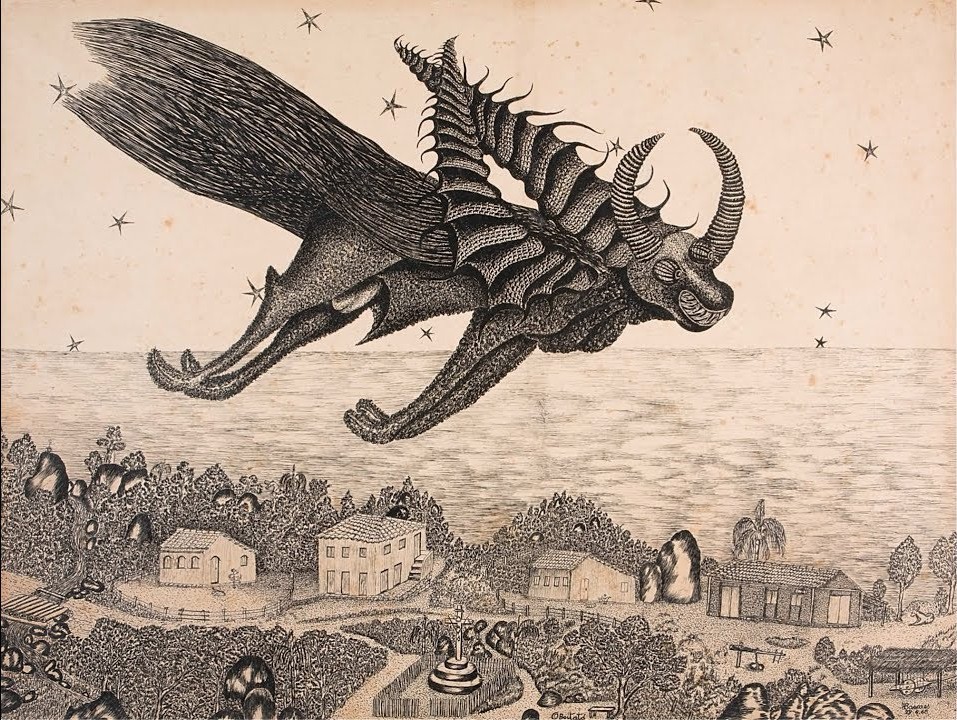
Some works, such as the one depicting the Boitatá flying over the island, carry multiple meanings. One interesting interpretation is that Cascaes saw himself reflected in this mythical being, observing from above the transformations brought by modernization: giant buildings replacing old houses, traditional architecture giving way to concrete… A feeling of melancholy and loss that shines through the artwork, as if the Boitatá were the artist himself witnessing the destruction of local Azorean culture by the claws of capitalism.
This criticism of progress becomes even more explicit in The Great Witch. The imposing figure of the witch steps over houses, churches, and trees, while her feet are boots decorated with designs resembling tall buildings, leaving behind a trail of coins. The image conveys Cascaes’ view of the advance of capital on the island of Florianópolis: a destructive force that, under the pretense of development, wipes out popular culture and Azorean traditions.
In addition to his sculptures and drawings, Cascaes dedicated much of his life to collecting stories of witchcraft in the Azorean communities of Pântano do Sul, Barra, and Costa da Lagoa. He not only wrote down these stories, but also made an effort to preserve the local dialect, keeping expressions, accents, and even grammatical “mistakes.” This attention to language is one of the defining features of his literature.
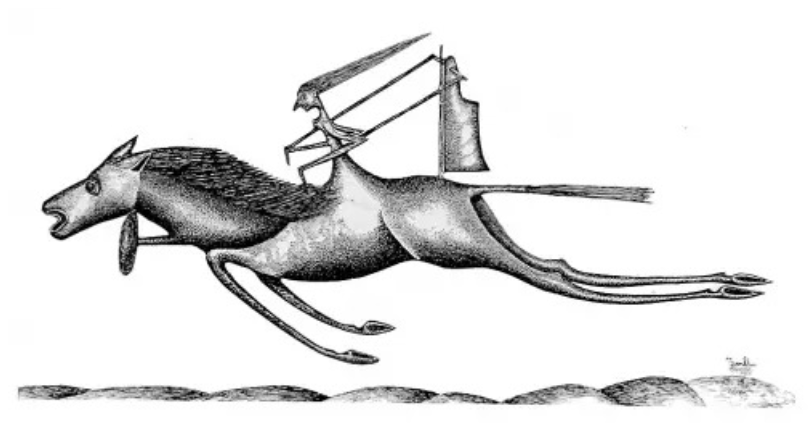
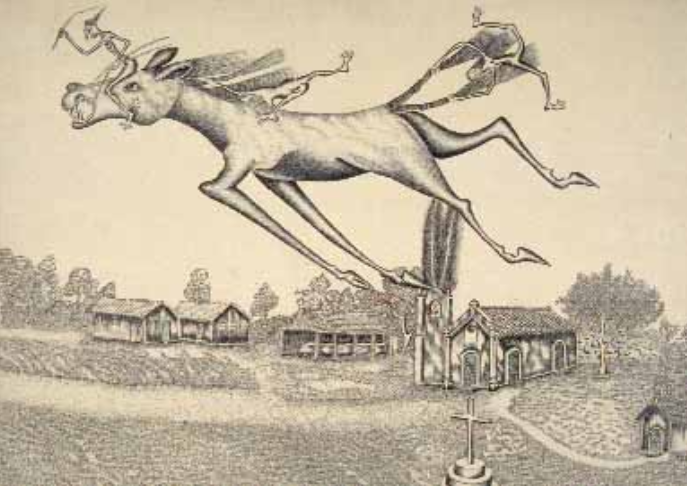
In some stories, Cascaes depicts witches stealing canoes and disturbing fishermen. According to anthropologist Sônia Maluf, this carries a deeper meaning: when witches tie knots in horses’ manes or steal canoes, they are symbolically invading the male space within Azorean culture. At that time, men would go fishing and ride horses, while women stayed home taking care of children and making bobbin lace. In this sense, these witches represent women who challenged the limits imposed by patriarchy.
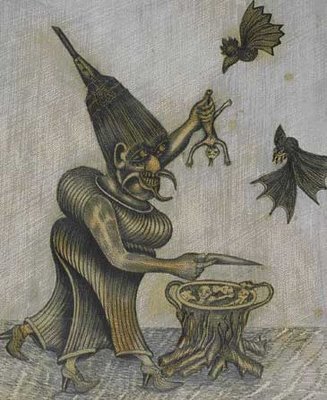
But these same women were also seen as dangerous, capable of “bewitching children.” When a baby became ill, people would quickly blame some witch. Cascaes even recorded scenes like this, depicting a witch supposedly casting a spell on a baby. Here, the witch leaves the male sphere and invades the female one, being perceived as a threat to domestic life. Even so, as Sônia Maluf points out, she is not truly evil: she is simply a woman who refuses to accept the roles that Azorean society tried to impose on her.
Drawing by Franklin Cascaes, Victor Meirelles Museum. Photo: museus.gov
In the end, it is possible to notice a very clear difference between the anthropological witch and The Great Witch. At first, Cascaes merely recorded traditional stories, with witches stealing canoes, horses, or “bewitching” children. But later, he reinvented the figure of the witch through The Great Witch: here, what is truly frightening is not the rebellious or transgressive woman, but Capital itself, this force that arrives destroying popular culture and erasing Azorean roots. According to the artist, the real evil is not the rebellious woman, but Capital, which destroys traditions and threatens Azorean identity.
Cultural tourism in Florianópolis
For visitors who explore Florianópolis with attentive eyes, Franklin Cascaes is not just a name in books, he is spread throughout the city. His legacy has become a meeting point between tourism, art, and cultural identity.
The main place for this immersion is the Museum of Archaeology and Ethnology of UFSC (MArquE). There, most of Cascaes’ collection is preserved: witch sculptures, drawings, manuscripts, and records of Azorean folklore. Walking through the room dedicated to Cascaes is almost like stepping into a portal to old Florianópolis.
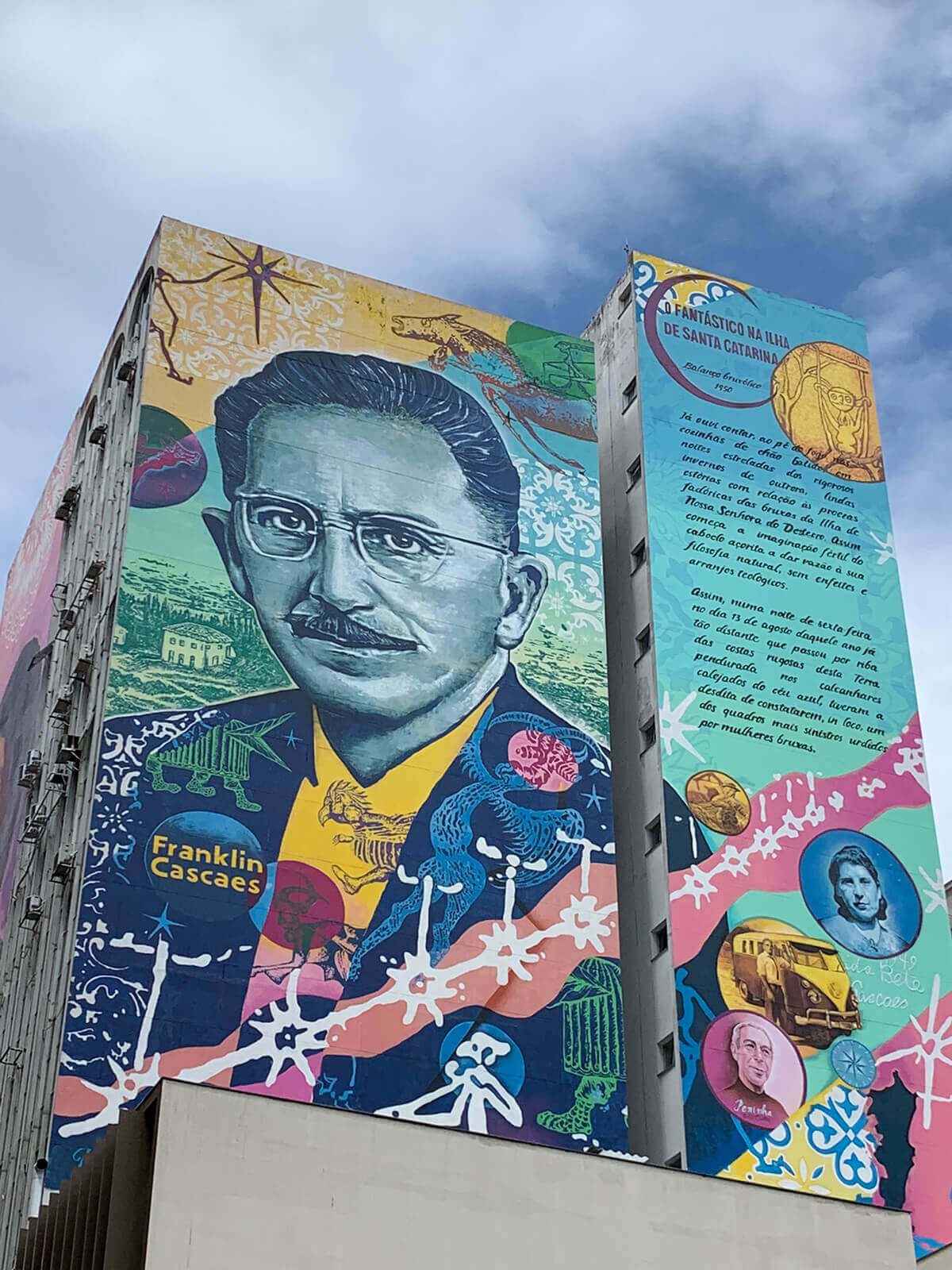
But Cascaes also appears outside museums. His name is given to schools, streets, and cultural centers, and his witches inspire murals, artistic interventions, and even souvenirs scattered across the island. In places such as Lagoa da Conceição, Ribeirão da Ilha, Santo Antônio de Lisboa, and Costa da Lagoa, the atmosphere he so carefully documented still survives: old houses, fishing traditions, stories told at dusk, and that feeling that the past still walks alongside the present.
Franklin Cascaes mural, downtown Florianópolis. Photo: Revista Amar.
To conclude…
Getting to know Franklin Cascaes’ work means understanding that Florianópolis goes far beyond its postcard image. It is realizing that, behind the beaches and modern tourism, there is an island made of legends, conflicts, affection, and cultural resistance. Cascaes’ witches are not just folkloric characters: they question, provoke, and remind us that identity is not built with concrete, but with memory.
Gabriela Scherer
Author
I am a film student, passionate about culture and stories that connect people. I have been dancing for over seven years and have explored seven countries in search of new inspiration. Between a photo and a good conversation, I continue living art every day.



 English
  Portuguese
  Spanish